CRYPTARITHMS
How to SolvePuzzles.Cryptarithms
A cryptarithm replaces digits with letters. Each letter always means the same digit. Your job is to decode the mapping and solve the arithmetic.
Core rules
Using the elimination grid
Many puzzles include an elimination grid to help you track possibilities. Think of it as a clean way to keep your pencil notes organized.
- Each letter has a row (or column) of digits 0–9.
- Mark digits that a letter cannot be.
- When only one digit remains for a letter, that letter is solved.
- Start by eliminating leading zero for any leading letter.
- When you solve a letter, eliminate that digit from every other letter.
- Use carries, remainders, and forced columns to eliminate quickly.
A reliable solving strategy
- Look for columns where only one or two letters appear.
- In long division, check the first subtraction step and any remainder column.
- In addition/subtraction, start at the rightmost column (ones place).
- Write small carry values above columns.
- In long division, each step must be consistent with the divisor.
- Even one carry can eliminate many digit options.
- Maintain a small list of possible digits for each letter.
- When a letter is solved, remove that digit from all other letters.
- If a contradiction appears, back up one assumption.
- When most letters are solved, compute the full arithmetic.
- Make sure every intermediate step matches.
- If anything fails, a single letter is wrong. Re-check the earliest forced step.
Logic, algebra, or a mix
There is no single correct approach. Some solvers prefer pure logic, others write equations and solve algebraically, and many use a combination.
- Use carries, remainders, and column constraints to eliminate options.
- Great when the puzzle is designed to be solved without guessing.
- Pairs well with the elimination grid.
- Translate parts of the puzzle into equations.
- Use known-digit constraints (0–9, distinct letters, no leading zeros).
- Best when a few equations quickly narrow the solution.
- Start with logic to reduce options.
- Then use one or two small equations to finish.
- Verify with full arithmetic at the end.
FAQ
Ready to solve?
Try a sample puzzle or browse published books and series.
Example
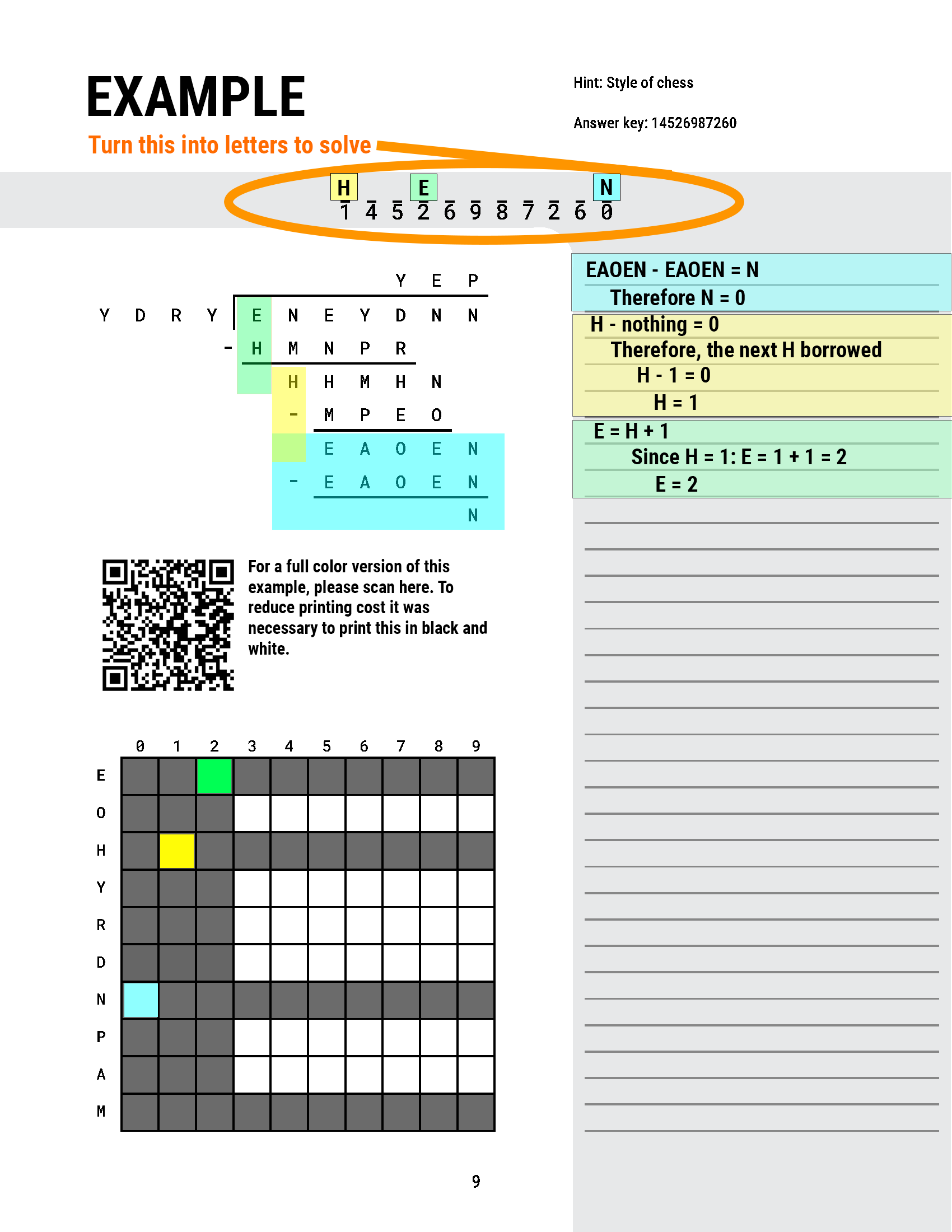
This is an example worksheet page showing a partially solved Long Division Cryptarithm.